
Conducted by researchers from the School of Civil Engineering at the Technical Colleges:
Comparison of the Life Cycle and Costs of Seven Methods for Preserving and Maintaining Asphalt Pavement
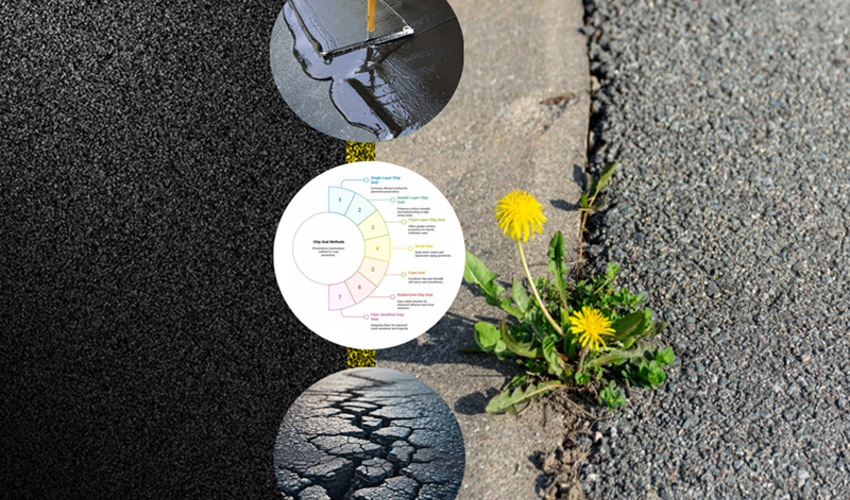
According to the Public Relations Office of the College of Engineering, a specialized research study, employing a life-cycle assessment and life-cycle cost analysis approach, has evaluated seven conventional chip seal asphalt pavement methods in terms of their environmental and economic impacts.
Dr. Mohammadzia Alavi, a faculty member of the Department of Civil Engineering at the Faculty of Engineering and the lead researcher on this project, stated, “This study, conducted using SimaPro software and the Ecoinvent database, shows that the 'single-layer chip seal' and 'scrub seal' methods are the most cost-effective options in terms of initial and annual costs, while the 'triple-layer chip seal' and 'rubber chipseal' methods are the most expensive. However, from an environmental perspective, despite its higher cost, the rubber chip seal has the lowest annual greenhouse gas emissions due to its longer service life.”
The faculty member of the College of Engineering added, “This study, titled 'Comparative Life-Cycle Assessment of Chipseal Paving Methods: Cost and Environmental Implications,' examined seven different methods, including single-layer, double-layer, and triple-layer chipseal, scrub seal, cape seal, fiber-reinforced chipseal, and rubber chipseal.”
He noted that the system boundary for this study was defined from the extraction of raw materials to the implementation stage (cradle-to-gate), and the functional unit considered was one square meter of protective surface.
Regarding the economic assessment, Dr. Alavi also stated: “The implementation costs of documented projects in the United States and the Iranian price list have been calculated on an annual basis with a 10% discount rate.”
The faculty member of the College of Engineering stated: “The findings show that the single-layer chipseal and scrub seal methods have the lowest costs, at $88.1 and $6.2 per square meter, respectively, while the rubber and three-layer methods are the most expensive, at $60.7 and $28.6 per square meter, respectively.” However, when these figures are annualized based on the lifespan of each method, single-layer chip seal ($5.0) and scrub seal ($69.0) still remain the most cost-effective options.”
Emphasizing that, from an environmental perspective, the Scrub-Seal method, with emissions of approximately 1,545 grams of carbon dioxide equivalent per square meter, has the lowest pollution and also performs best in terms of human health, ecosystem, and resource endpoints, he stated: “In contrast, the Cap-Seal method (with 5,301 grams) and the three-layer Chip-Seal method perform worst in terms of greenhouse gas emissions. Interestingly, when these values are normalized based on the service life of each method (in years), the rubber chip seal, despite its higher initial cost and emissions, has the lowest annual greenhouse gas load (approximately 5,177 grams per year) due to its longer service life.”
According to the researcher, a Monte Carlo uncertainty analysis (with 1,000 runs and a 95% confidence interval) also confirmed the robustness and reliability of the ranking of these methods. The results of this study clearly demonstrate the existence of interrelationships, and at times trade-offs, between cost and environmental impacts, and underscore the importance of considering the service life of the pavement when selecting conservation strategies.
These findings underscore the importance of considering the service life of the pavement when selecting the optimal method.
https://www.sciencedirect.com/science/article/pii/S2214509525014615
Your Comment :