
New achievement of the School of Electrical and Computer Engineering at the College of Engineering in energy storage technology
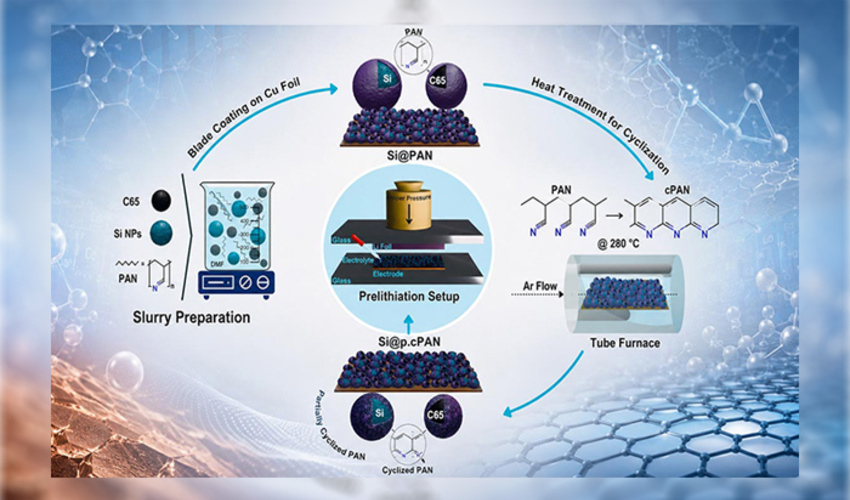
According to the public relations of the College of Engineering, lithium batteries are today one of the most important strategic technologies in the world and play an important role in the development of electric transportation, the use of renewable energy and the production of electronic equipment. One of the main challenges in upgrading these batteries is increasing energy storage capacity and improving their longevity.
In this regard, researchers from the energy storage laboratory of the Faculty of Electrical and computer engineering of the College of Engineering of the University of Tehran have presented an innovative method to improve the performance of silicon anodes of lithium batteries in a new study. Silicon is considered one of the promising options for replacing common graffiti anodes due to its high storage capacity of lithium ions, but its large volumetric changes during charging and discharging have challenged the widespread use of this material.
Researchers at the University of Tehran, in this study, using a polyacrylonitrile polymer coating and employing the rapid “pre-lithiation” process, succeeded in improving the electrochemical stability and performance of silicon anodes. In this method, the electrode is pre-lithiated in just three minutes through direct contact with lithium metal—a process that, while partially compensating for initial lithium loss, helps form a faster and more stable protective layer on the anode's surface.
The results of the experiments showed that preliminary anodes were able to maintain 71.7 percent of their initial capacity after 150 charge and discharge cycles, while this was 63.6 percent in samples lacking this process. The colony efficiency of these electrodes has also reached about 99%, indicating their high stability of performance.
In the NMC811 cathode-equipped full battery test, the initial colony yield increased from 44 percent to about 79 percent, and the special capacity of the first cycle increased from 94 to 159 mAh per gram. In addition, the capacity retention rate after 100 charge and discharge cycles increased from 52 percent to 69 percent, indicating the significant impact of this technology on improving the performance of lithium batteries.
The most important advantages of the method are its simplicity, low cost, high speed and development capability for industrial scale production, characteristics that can pave the way for the commercialization of this technology.
The results of the study were published in the prestigious Journal of Power Sources (one of the leading international publications in the field of battery technology and energy storage systems).
This research is an effective step in the development of high-performance and sustainable battery technology and could pave the way for the wider use of silicon anodes in the next generation of lithium batteries.
The study was conducted in collaboration with Dr. Soraya hornam, Dr. Sadegh ghorbanzadeh, Dr. Mohammad Reza yasubi, researchers from the energy storage laboratory of the University of Tehran, and led by Dr. Zainab Senai, dean of the School of Electrical and computer engineering and head of the energy storage laboratory of the University of Tehran.
This article is available at the following link:
https://www.sciencedirect.com/science/article/abs/pii/S0378775325017021
Your Comment :