
Improving the Performance of Recycled Cold Asphalt Mixtures through Polymer Modification of Emulsified Asphalt Binder
A Specialized Approach by Researchers at the University of Tehran’s College of Engineering to Produce Cold Asphalt Mixtures with Improved Performance
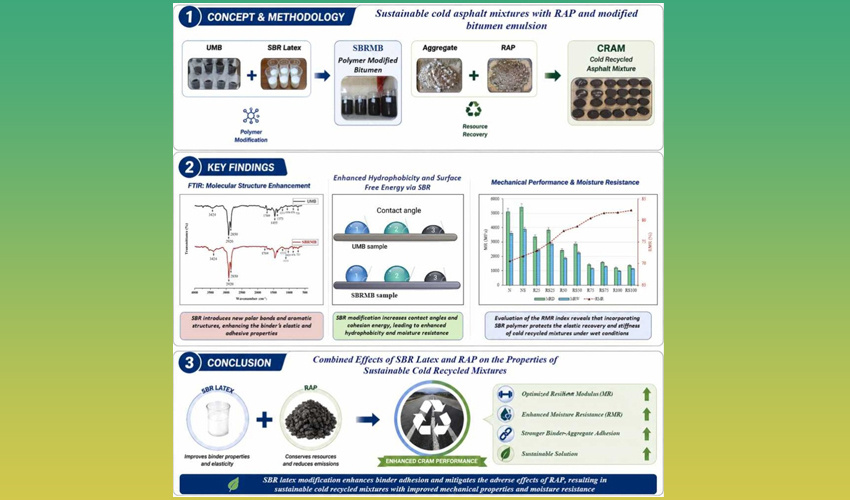
According to the Public Relations Office of the College of Engineering, researchers from the School of Civil Engineering at the College of Engineering, in collaboration with the Iran University of Science and Technology, investigated the effects of the simultaneous use of reclaimed asphalt pavement (RAP) and emulsified asphalt binder modified with styrene–butadiene rubber (SBR) latex on the performance of cold asphalt mixtures.
Dr. Mohammad Zia Alavi, a faculty member of the School of Civil Engineering at the College of Engineering, stated: “In this study, mixtures containing nominal RAP contents of 0, 25, 50, 75, and 100 percent were produced using both modified and unmodified emulsified asphalt binders. The properties of the asphalt binder and the performance of the mixtures were evaluated through a series of physical, chemical, mechanical, and moisture-related tests.”
He added: “The results showed that the addition of SBR increased the softening point of the asphalt binder from 54 to 64°C and increased the penetration index from 0.41 to 2.28, indicating a reduction in the temperature susceptibility of the binder. In addition, the cohesion energy of the modified mastic increased by approximately 16.2 percent.”
Dr. Alavi further stated: “Increasing the RAP content to a nominal level of 100 percent reduced Marshall stability by 24.2 percent; however, modification of the asphalt binder with SBR partially compensated for this reduction. In contrast, indirect tensile strength increased by up to 15.2 percent with increasing RAP content, while moisture resistance indices also improved with the use of RAP and SBR.”
However, a high RAP content resulted in a noticeable reduction in flow value and in the resistance of the mixtures to permanent deformation. The addition of SBR improved these indicators, but at high RAP contents, it was unable to restore the performance of the mixtures to the level of the control mixture.
According to Dr. Alavi, these findings demonstrate the potential of using SBR and recycled materials to produce more durable cold asphalt mixtures. Nevertheless, optimization of the mix design, along with pilot projects and field monitoring, is essential before widespread application.
This research was conducted by Dr. Mohammad-Ali Ziari, Dr. Mohammad Zia Alavi, Dr. Massoud Palasi, and Dr. Mehdi Zal-Nejad, and its findings were published in 2026 in the journal Case Studies in Construction Materials.
https://www.sciencedirect.com/science/article/pii/S2214509526004973
Your Comment :