
Optimizing Design in Open-Pit Mines and Large-Scale Civil Engineering Projects
Conducted by Researchers at the School of Mining Engineering, College of Engineering, University of Tehran
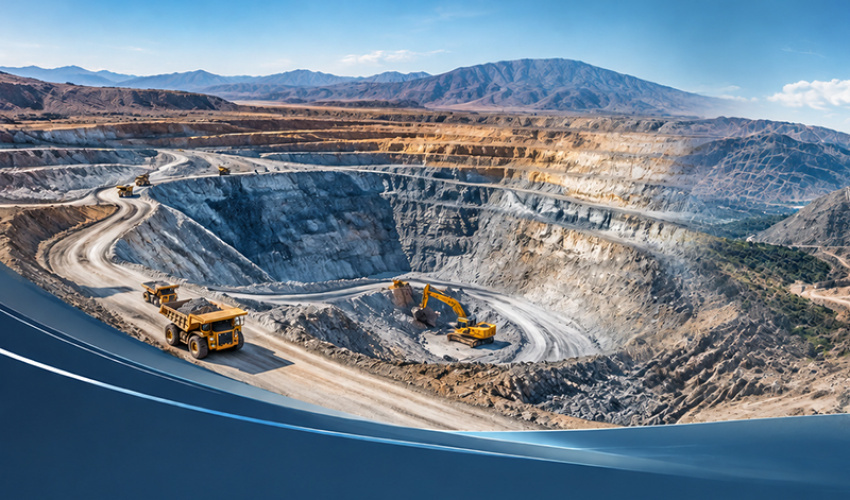
According to the Public Relations Office of the College of Engineering, researchers at the School of Mining Engineering have employed advanced numerical methods to evaluate the effects of scale and anisotropy on the mechanical properties of jointed rock masses.
Dr. Mojtaba Bahaaddini, a faculty member at the School of Mining Engineering, College of Engineering, University of Tehran, and his research collaborators conducted a comprehensive study investigating the effects of scale and anisotropy on the mechanical properties of jointed rock masses.
Dr. Bahaaddini explained: “This research employs the Synthetic Rock Mass (SRM) approach, integrating two numerical methods—the Discrete Element Method (DEM) and Discrete Fracture Network (DFN)—to introduce a novel approach for estimating the representative elementary volume (REV) at large scales. The proposed method can serve as an effective tool for engineering design in open-pit mines and large-scale civil engineering projects.”
He further noted: “Predicting the mechanical behavior of rock masses at large scales has long been a major challenge in rock engineering. This complexity arises primarily from pronounced scale dependence and anisotropy associated with geological discontinuities. Conventional methods for estimating the representative elementary volume (REV) have certain limitations, whereas numerical simulations offer a reliable and efficient alternative for addressing this challenge.”
In this study, the findings of which have been published in a reputable international scientific journal, the researchers investigated the effects of scale and anisotropy in a jointed rock mass subjected to uniaxial loading. The analysis was conducted using the Synthetic Rock Mass (SRM) approach, which integrates the Discrete Element Method (DEM) and Discrete Fracture Network (DFN).
According to Dr. Bahaaddini, the active slope of a large open-pit iron ore mine was selected as the case study. The discontinuities present in the slope were mapped using close-range photogrammetry, and a validated DFN model was subsequently generated based on the collected data. The intact rock was simulated using the Bonded Particle Model (BPM). To maintain computational efficiency, particle sizes were increased as the dimensions of the numerical models grew.
The researchers conducted uniaxial compression tests on 54 numerical models with different dimensions and orientations, yielding several significant findings. The results showed that both uniaxial compressive strength (UCS) and the deformation modulus of the rock mass decreased as specimen dimensions increased. However, the deformation modulus exhibited a more pronounced rate of reduction.
Based on the findings, the mechanical representative elementary volume (Mechanical REV) of the investigated rock mass was determined to be 5 × 5 × 10 m³. The results also revealed substantial anisotropy in the rock mass, with anisotropy being more pronounced in uniaxial compressive strength than in the deformation modulus.
The researchers further found that, although UCS and the deformation modulus became less sensitive to scale changes at dimensions greater than 5 m, anisotropic behavior persisted at larger scales. This persistence was primarily attributed to the dominant influence of joint-set orientations.
One of the key contributions of this research is its identification of a relationship between the geometrical representative elementary volume (Geometrical REV) and the mechanical representative elementary volume (Mechanical REV). A particularly important practical finding is that the Geometrical REV can be used as an initial, practical indicator for estimating the Mechanical REV.
This finding provides an efficient and rapid tool for large-scale engineering design applications, including open-pit mines, rockfill dams, tunnels, and other civil engineering projects. It represents a significant step toward reducing engineering costs and improving the accuracy of predictions of rock mass behavior.
https://www.sciencedirect.com/science/article/abs/pii/S0266352X26004763
Your Comment :