
Conducted by a researcher from the School of Chemical Engineering: Tracking pollutants and diseases with smart sensors
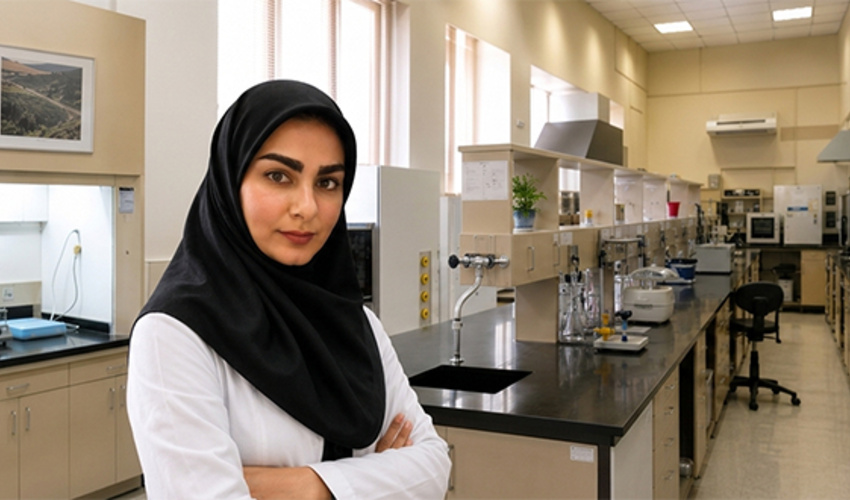
Dr. Samira Mehravar, a postdoctoral researcher at the School of Chemical Engineering of the College of Engineering, announced the advancement of research that has led to the development of new technologies in the fields of energy, environment, and health by utilizing engineered nanomaterials. This research is pursued in line with her expertise in the fields of nanotechnology and chemical engineering, with the aim of providing practical solutions to current challenges in the country and the world.
Referring to his research background, he stated: "In the first postdoctoral period, the focus was on designing advanced nanocatalysts for the conversion of greenhouse gases, which led to the registration of a patent in this field. The innovation of these catalysts was based on surface structure engineering and optimization of active interactions, and in the dry methane rearrangement process, it produced about 20% more hydrogen than the industrial FCR-4 catalyst with less active metal consumption. The results of this research were published in the form of two articles indexed in the ISI database.
The idea of a smart platform for monitoring pollutants was born
Dr. Mehravar said about his current research activity in the adsorption laboratory of the School of Chemical Engineering, University of Tehran, under the guidance of Dr. Shohreh Fatemi:
This research is defined as a "nanotechnological platform based on quartz crystal microscale arrays with nanostructured coatings for non-invasive detection and monitoring of volatile organic compounds in medical and industrial applications."
According to him, the detection of many environmental pollutants, as well as compounds in human exhaled air that can indicate metabolic diseases, still depends on complex, expensive and time-consuming equipment. Therefore, the main idea of the research is based on improving the performance of quartz crystal sensors for faster and more accurate detection of volatile organic compounds at very low concentrations. In this system, the use of targeted nanostructured coatings and molecularly imprinted polymers enhances the interaction between the sensor and target molecules and increases accuracy and selectivity.
The role of intelligence in increasing the accuracy of sensors
This researcher from the University of Tehran pointed out the difference between the new approach and conventional methods of measuring pollutants and added: "In traditional methods, the sensor output is usually limited to a single response, but in the smart approach, a set of sensor responses is analyzed simultaneously."
He explained: "The focus of this project is on extracting multivariate patterns from the response of different coatings; an approach that increases resolution, reduces the effect of confounding factors, and improves the reliability of res ults. This achievement can pave the way for the development of faster, more accurate, and more reliable monitoring tools in the fields of environment and health."
A novel achievement in the integration of nanomaterials and data analysis
Dr. Mehravar described the project's most significant achievement as the introduction of a novel framework for enhancing the performance of quartz crystal sensors by integrating engineered nanomaterials and multivariate data analysis.
He said: Within this framework, scattered sensor responses are transformed into meaningful, interpretable patterns. This approach aligns with emerging trends in smart monitoring and offers significant potential for diagnostic and environmental applications.
Widespread applications in health and the environment
According to this researcher, the developed technology can be used in various fields, including air quality monitoring, volatile pollutant control, enhancing safety in industrial environments, and developing noninvasive health monitoring methods based on breath analysis.
She adedd:
This technology can play a particularly effective role in diagnosing metabolic diseases by analyzing the compounds present in human breath. Moreover, the interdisciplinary nature of this project fosters collaboration and synergy among the fields of nanotechnology, chemical engineering, and data science.
Future Outlook and Commercialization Prospects
Dr. Mehravar, in conclusion, identified the next steps of this research as the development of target-specific coatings, evaluation of system performance under real-world conditions, and the refinement of data analysis models.
She stated:
“The long-term vision of this project is to develop intelligent monitoring systems capable of delivering accurate, rapid, and reliable information, while moving toward the commercialization of the technology in health and environmental sectors. This technology has the potential to play a significant role in improving quality of life and advancing next-generation diagnostic and monitoring tools.”
Your Comment :